Family guide
How to split Christmas costs with family: dinner, gifts and who pays
Every year the same question comes up: who pays for Christmas dinner? Often the hosts cover the groceries, the wine and dessert, while guests bring a gift or a bottle. That works as long as everyone feels it is fair. Here are the usual ways to split Christmas costs with family, how to choose between splitting per household or per person, and how to bring it up without making anyone uncomfortable.
6 min read
Show contents
In short
- For Christmas dinner, four options are common: the hosts pay for everything, everyone brings a dish, the groceries are split per household, or they are split per person.
- Splitting per household is simplest when families are about the same size. Splitting per adult is fairer when one household comes with six people and another with one.
- According to the National Retail Federation's 2025 holiday survey, US consumers planned to spend $890.49 each on the holidays, including $262.56 on food, decorations and other non-gift items.
- Example: $360 of shared costs for 3 households, or $120 per household. Claire paid $300 for groceries, Paul $60 for wine: Paul sends Claire $60, and Nadia and Sam send her $120.
- The key is to talk about it before the holidays, not after: you suggest a way to share, you don't hand out a bill.
How much does Christmas cost?
In its 2025 holiday survey of 8,247 US adults (October 1-7, 2025), the National Retail Federation found that consumers planned to spend an average of $890.49 on the holidays:
| Item | Average amount |
|---|---|
| Gifts for family and friends | $627.93 |
| Food, candy, decorations, cards and other seasonal items | $262.56 |
| Total | $890.49 |
These are averages per person. For the household hosting dinner, the food bill is often much higher: they buy for the whole table. That is why the question of splitting comes up.
Who pays for Christmas dinner? 4 options
| Option | How it works | Best for | Watch out for |
|---|---|---|---|
| The hosts pay | The hosts buy everything, guests bring a bottle or a dessert. | Families who take turns hosting each year. | Heavy for the hosts if the same people always host. |
| Everyone brings a dish | The menu is shared out: starter, main, sides, dessert, drinks. | Families who like to cook. | Dishes don't all cost the same (the turkey or roast costs more than the salad). |
| Per household | Shared costs are added up and divided by the number of households. | Households of similar size. | Unfair if one household brings six people and another one. |
| Per person | The total is divided by the number of adults (or guests), then each household pays for its members. | Households of very different sizes. | Decide in advance whether children count. |
A mix works well too: the hosts provide the home, the dishes and the energy bill, and only the dinner groceries are shared. Cooking for hours and doing the dishes is already a contribution.
Worked example: per household or per adult
Claire and Mark host Christmas with their two children. Paul, Claire's brother, comes alone, and Nadia and Sam come as a couple. Claire paid $300 for groceries, Paul brought $60 of wine. Nadia and Sam paid nothing up front. Total shared costs: $360.
| Household | Paid | Their share | Balance |
|---|---|---|---|
| Claire and Mark | $300 | $120 | +$180 (owed to them) |
| Paul | $60 | $120 | −$60 (he owes) |
| Nadia and Sam | $0 | $120 | −$120 (they owe) |
| Total | $360 | $360 | $0 |
| Household | Paid | Their share | Balance |
|---|---|---|---|
| Claire and Mark (2 adults) | $300 | $144 | +$156 (owed to them) |
| Paul (1 adult) | $60 | $72 | −$12 (he owes) |
| Nadia and Sam (2 adults) | $0 | $144 | −$144 (they owe) |
| Total | $360 | $360 | $0 |
Share = total shared costs ÷ number of households (or adults)
Balance = what was paid − the share
Per household: Paul sends $60 and Nadia and Sam $120 to Claire
Per adult: Paul sends $12 and Nadia and Sam $144 to Claire
Paul, who came alone, pays much less when you split per adult. That is often the fairest choice when households are different sizes. The same math works for a holiday trip together: see our guide to splitting group trip costs.
Group gifts, Secret Santa and a shared pot
- A group gift (for the grandparents, for example): one person buys it and the others pay them back equally or per household. Agree on the budget before buying, not after.
- Secret Santa: each adult draws one person to buy a gift for, with a shared spending limit. Everyone spends the same amount and nobody has to pay anyone back.
- A shared pot: everyone pays the same amount up front, and the organizer uses it for shared purchases. Handy for a big gift or a holiday rental.
- Gifts for the kids usually stay with each family, unless you agree otherwise.
Talking about money at Christmas without hurt feelings
- Bring it up early, while planning the holidays, not on December 26. A rule agreed in advance is not awkward.
- Suggest, don't impose: "shall we split the groceries between the three households?" goes down better than announcing an amount.
- Keep everyone's means in mind: a student or a single parent can contribute a dish or their time rather than money.
- Keep track of who paid for what: with several payers and several households, amounts are easy to forget.
- Settle up quickly, within the week, so nobody is still out of pocket in January.
Take turns hosting
Many families sidestep the question by alternating: one year at one home, the next year at another. Over a few years, everyone hosts and everyone is a guest. It only works if everyone is able to host.
Which app to split Christmas costs
For a single dinner, a note on your phone can be enough. Once there are several payers, group gifts and a stay over several days, an expense-splitting app saves you redoing the math by hand.
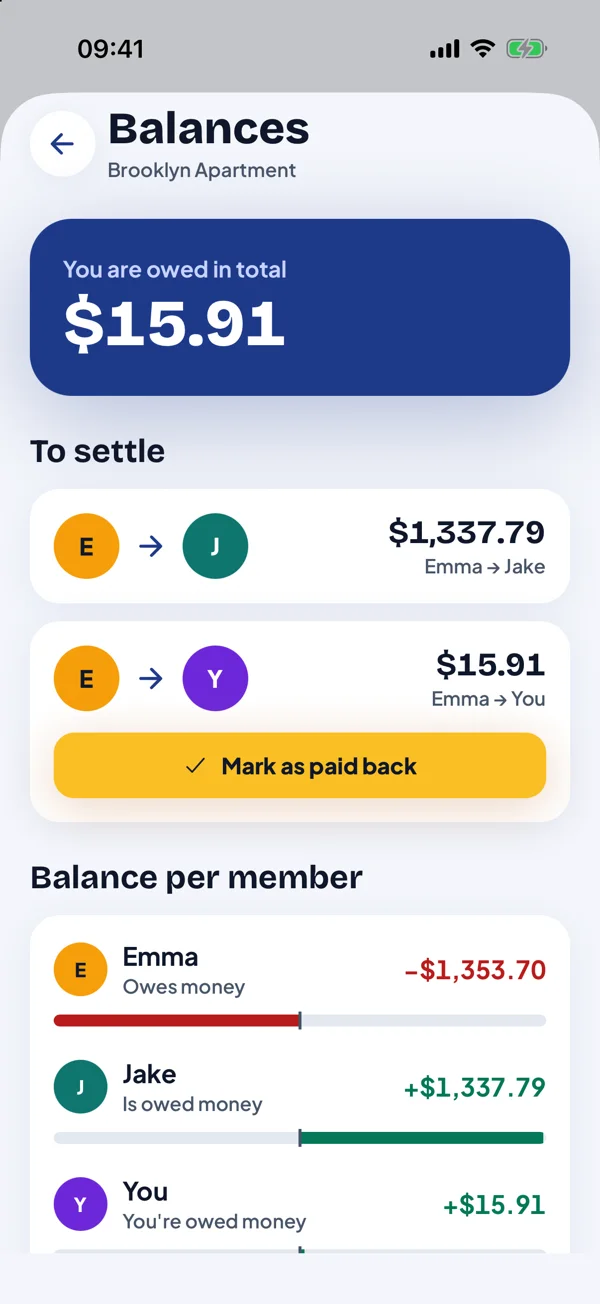
With SAVY, you create a household for the holidays (or use your family's) and invite the others with a link valid for 7 days. Each person adds what they paid (groceries, wine, a group gift) and chooses who takes part. SAVY works out who owes whom with a simplified list of repayments. To split per household, one member per family is enough. The free plan includes unlimited expenses, equal splits, up to 4 members and 1 household of your own (you can always join households you are invited to). SAVY Plus, one subscription for the whole household, adds unlimited members and households and uneven splits, for example 2 shares for a couple and 1 for someone on their own.
SAVY doesn't connect to your bank: expenses are added by hand, and the app never moves money. Everyone pays back the way they usually do. For the household budget the rest of the year, see our guide on how to make a family budget.
Frequently asked questions
Who should pay for Christmas dinner?
There is no rule. In many families the hosts pay and guests bring a bottle or a dessert. When the same people always host, or the dinner is expensive, families split the groceries per household or per person. What matters is agreeing beforehand.
Should Christmas costs be split per household or per person?
Per household when families are about the same size: it is the simplest math. Per adult when sizes are very different, for example a couple with three kids and someone on their own. Decide in advance whether children count.
Is it rude to ask family to chip in for Christmas dinner?
Not if you suggest it early and frame it as sharing. Asking for money after the meal, without warning, goes down much worse. Another option is to share out the menu so everyone brings a dish or the drinks.
How do you split a group gift with family?
Agree on the budget together, pick one person to buy it, then everyone pays them back equally or per household. A shared pot paid up front saves the buyer from fronting the money. Keep track of who has paid so you don't chase anyone by mistake.