Roommate guide
How to split groceries with roommates: 4 methods that work
Rent gets split once a month. Groceries come back every week, paid by a different person each time. That is often where roommate finances slip: one person always fronts the money, another eats more, receipts get lost. Here are four ways to split groceries with roommates, what usually counts as shared, and how to settle up at the end of the month.
6 min read
Show contents
In short
- There are four common ways to split groceries with roommates: share everything equally, share only the staples and buy your own food, pay into a monthly grocery kitty, or take turns doing the shopping.
- Shared staples is often the easiest to keep going: you split what everyone uses (oil, salt, coffee, toilet paper, dish soap, cleaning supplies) and each person buys the rest for themselves.
- Whatever the method, write down who paid for what and settle up once a month instead of after every trip to the store.
- Example: 3 roommates spend $450 on shared groceries in a month, or $150 each. Alex paid $230, Sam $150 and Jordan $70. Jordan sends Alex $80, and everyone is even.
- Different diets, time away and a couple in the apartment are handled by choosing who takes part in each purchase, or by counting shares.
Four ways to split groceries with roommates
No method is best for everyone. The right one depends on your habits: do you cook together, do you eat the same things, does anyone actually like grocery shopping?
| Method | How it works | Best for | Watch out for |
|---|---|---|---|
| Share everything | All groceries are split equally, whoever paid. | Roommates who cook and eat together. | Unfair if one person eats much more or is often away. |
| Shared staples + your own food | Basics are shared, each person buys their own meals. | Roommates with different schedules or diets. | Agreeing on what goes on the staples list. |
| Grocery kitty | Everyone pays the same amount each month, one person shops with it. | Roommates who want to avoid paybacks. | Someone has to manage the money and top it up. |
| Take turns | Roommates do the shared shopping in rotation. | Small households of 2 or 3. | Amounts vary week to week, so you still need to settle up. |
How to run a grocery kitty
With a kitty, each roommate puts in a fixed amount at the start of the month, in cash in a jar or by transfer to a shared account or money pool. Whoever does the shopping pays from it, so nobody has to pay anyone back day to day.
- Set the amount from what you spend on shared groceries in a normal month, plus a small buffer.
- Pick one person to manage it: they keep the receipts and say when it runs low.
- Check it at the end of the month: leftover money rolls over or goes back in equal parts. If it ran short, everyone tops it up by the same amount.
Where a kitty goes wrong
When a roommate pays out of pocket because the kitty is empty, the kitty no longer covers everything: that payment has to be written down and paid back. Small advances with no record are what cause tension.
Worked example: settling up groceries at the end of the month
Alex, Sam and Jordan split all shared groceries equally. Whoever has time does the shopping and pays with their own card. At the end of the month, they add it up.
| Roommate | Paid | Share | Balance |
|---|---|---|---|
| Alex | $230 | $150 | +$80 (is owed) |
| Sam | $150 | $150 | $0 |
| Jordan | $70 | $150 | −$80 (owes) |
| Total | $450 | $450 | $0 |
Each share = total shared groceries ÷ number of roommates
$450 ÷ 3 = $150
Balance = what you paid − your share
Jordan sends Alex $80, and everyone is even
One transfer replaces a dozen small paybacks during the month. If you also split rent and utilities, put everything in the same calculation. Our guide to splitting rent with roommates covers rooms of different sizes.
Different diets, time away, couples: the special cases
- A vegetarian roommate: meat bought for the others is split only between the people who eat it. For each purchase, choose who takes part.
- A roommate who is away (vacation, internship, weekends at their parents'): they don't pay for groceries bought while they are gone. Shared supplies like toilet paper and cleaning products usually stay shared.
- A couple in the apartment: for food, they usually count as two shares. For shared supplies, talk it through: two people use more toilet paper than one.
- A roommate who eats a lot more: switch to shared staples rather than commenting on every meal.
- Guests: an occasional dinner guest goes into the shared pot; a guest who is there almost every night is worth a conversation.
Set these rules when someone moves in, at the same time as the rent split. For utilities and whose name goes on each account, see our guide to splitting bills with flatmates.
Avoiding money fights over groceries
- Log every shared purchase when it happens, with the amount and who paid. A receipt in a pocket gets forgotten.
- Settle up once a month, on a fixed date, and start again from zero.
- Don't let one person front all the groceries: even if they get paid back, they are carrying the household's cash flow.
- Bring it up at the first gap, not after three months. If a debt really grows, our guide on a roommate not paying covers the next steps.
Which app to split groceries with roommates
A shared spreadsheet works as long as everyone fills it in. An expense-splitting app saves you the end-of-month math: each person adds what they pay, and the balances update on their own.
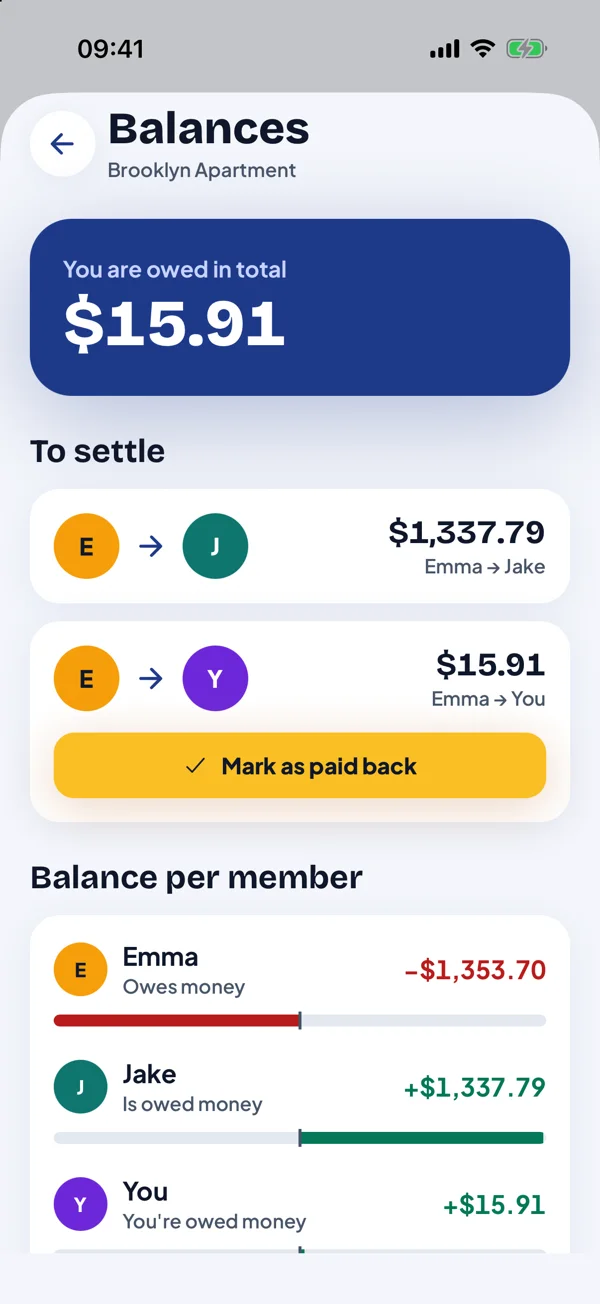
With SAVY, each roommate joins the household with an invite link valid for 7 days. After each shopping trip, whoever paid adds the expense and chooses who takes part: everyone for the staples, only some people for a specific item. SAVY works out who owes whom with a simplified list of repayments, and marking a repayment takes one tap. The monthly stats show what the household spends on groceries. The free plan includes unlimited expenses, equal splits and up to 4 members. SAVY Plus, paid by the household owner and unlocked for the whole household, adds unlimited members, uneven splits (for example two shares for a couple), category budgets with alerts, such as a grocery budget, and CSV and PDF export.
SAVY doesn't connect to your bank: expenses are added by hand, and the app never moves money. Roommates pay each other back the way they usually do.
Frequently asked questions
How should roommates split groceries?
Four methods are common: split everything equally, share only the staples (basics and cleaning supplies) and buy your own food, pay into a monthly grocery kitty, or take turns doing the shopping. Whichever you pick, write down who paid for what and settle up once a month.
Should roommates have a shared grocery fund?
It is not required. A kitty avoids day-to-day paybacks but needs one person to manage and top it up. Without one, each person pays with their own card and you even out at the end of the month, with one transfer per person.
What if one roommate eats much more than the others?
The simplest fix is to switch to shared staples: you split only what everyone uses, and each person buys their own meals. You can also leave that roommate out of purchases that don't concern them, or give them a bigger share if they agree.
Do toilet paper and cleaning supplies count as shared groceries?
Yes, in most shared homes. Toilet paper, dish soap, sponges, trash bags and cleaning products benefit everyone and are split equally, even when each person buys their own food.