Friends guide
How to split New Year's Eve costs with friends: food, drinks and who pays
A New Year's Eve party with friends usually means one person hosts, two do the grocery run, someone brings the champagne and someone else books the ride home. By January 1st, nobody remembers who paid for what. Here are the usual ways to split New Year's Eve costs, how to handle drinks when not everyone drinks, a worked example and how to settle up without chasing your friends for three weeks.
6 min read
Show contents
In short
- For a New Year's Eve party with friends, four methods are common: everyone brings something, a shared pot paid up front, a fixed contribution per person, or tracking who paid what and splitting afterwards.
- Only shared costs are split: food, drinks, decorations, renting a venue or a cabin. A ride home is split between the people who took it, not the whole group.
- Alcohol can be split only between the people who drink: it is a separate expense with its own participants.
- Example: $330 of costs for 6 friends, including $120 of alcohol for 4. Those who drink pay $65, those who don't pay $35.
- The simplest approach is to state the rule in the invitation and settle everything in the first week of January.
What gets split (and what doesn't)
Before picking a method, agree on what counts as a shared cost. Usually:
- Split between everyone: food and snacks, soft drinks, decorations, disposable plates and cups, renting a venue or a cabin.
- Split between part of the group: alcohol (between those who drink), the taxi or rideshare home (between those who took it), breakfast on January 1st (between those who stayed over).
- Not split: what people buy for themselves (an outfit, their favorite bottle they take home), and usually the place itself when a friend hosts at home.
Hosting already has a cost: cleaning, utilities, warning the neighbors. That is why hosts often skip part of the grocery bill, or guests bring dessert or an extra bottle.
4 ways to split New Year's Eve party costs
| Method | How it works | Best for | Watch out for |
|---|---|---|---|
| Everyone brings something | Share out the list: snacks, mains, dessert, champagne, soft drinks. | Small groups of close friends. | Contributions don't cost the same (champagne costs more than chips). |
| Shared pot up front | Everyone pays the same amount, the organizer buys everything with it. | Big parties, renting a venue or a cabin. | Decide what happens to leftover money or an overspend. |
| Fixed amount per person | The host announces a price ("$30 each") and takes care of everything. | When one person organizes it all. | The host fronts everything and carries the risk if costs run over. |
| Track and split afterwards | Several people pay for things, then you add it up and work out who owes whom. | Groups where several people do the shopping. | You need to keep track of every expense. |
Methods mix well: a shared pot for the venue and groceries, then an after-the-fact split for the ride home and last-minute purchases.
What about friends who don't drink?
Alcohol is often a big part of a New Year's Eve budget. Asking a friend who doesn't drink, is driving or is pregnant to pay for the champagne quickly feels unfair. The fix is simple: treat alcohol as a separate expense, split only between the people who drink it.
One expense, its own participants
Instead of one total divided by everyone, record each expense with the people it applies to. Groceries: all 6. Champagne: the 4 who drink. The ride home: the 3 who took it. The math then takes care of itself.
Worked example: a party for 6
Leah hosts five friends: Hugo, Ines, Tom, Nora and Malik. Nora and Malik don't drink alcohol. Leah paid $180 for groceries, Hugo $120 for champagne and wine, Ines $30 for decorations. Groceries and decorations are split between all 6, alcohol between the 4 who drink.
Groceries + decorations: ($180 + $30) ÷ 6 = $35 each
Alcohol: $120 ÷ 4 = $30 per person who drinks
Share for Leah, Hugo, Ines and Tom: $35 + $30 = $65
Share for Nora and Malik: $35
| Person | Paid | Share | Balance |
|---|---|---|---|
| Leah | $180 | $65 | +$115 (is owed) |
| Hugo | $120 | $65 | +$55 (is owed) |
| Ines | $30 | $65 | −$35 (owes) |
| Tom | $0 | $65 | −$65 (owes) |
| Nora | $0 | $35 | −$35 (owes) |
| Malik | $0 | $35 | −$35 (owes) |
| Total | $330 | $330 | $0 |
Five payments settle it: Tom sends Leah $65, Nora sends Leah $35, Ines sends Hugo $35, Malik sends Hugo $20 and Leah $15. If everything had been divided by 6, Nora and Malik would have paid $55 each, including $20 for drinks they never had.
Venue, cabin or weekend: when the party lasts more than one night
When the group rents a venue, a cabin or an apartment for New Year's, the rental becomes the biggest cost. It is usually split equally between everyone who stays, even late arrivals. Collect a deposit from each person before booking: you are the one committing to the host, not the group.
For a stay of several days, with people arriving and leaving at different times, the math is closer to a vacation: see our guide on splitting group trip costs, with its calculator.
Avoiding money drama on January 1st
- Put the rule in the invitation: "we split the food, drinks only between those who drink, roughly $30 to $40 each". Nobody is surprised later.
- Keep receipts or log each purchase when it happens, with who it applies to.
- Set a budget before shopping, especially for alcohol: it is the line that runs over fastest.
- Don't count leftovers: splitting three half-empty bottles at the end of the night causes more awkwardness than it saves.
- Settle up in the first week of January, while everyone still remembers the party.
Which app to split New Year's Eve costs?
For a single party, a free group app like Tricount does the job well. If you already share expenses with the same people the rest of the year (as roommates, as a couple, with close friends), it makes sense to keep everything in one place.
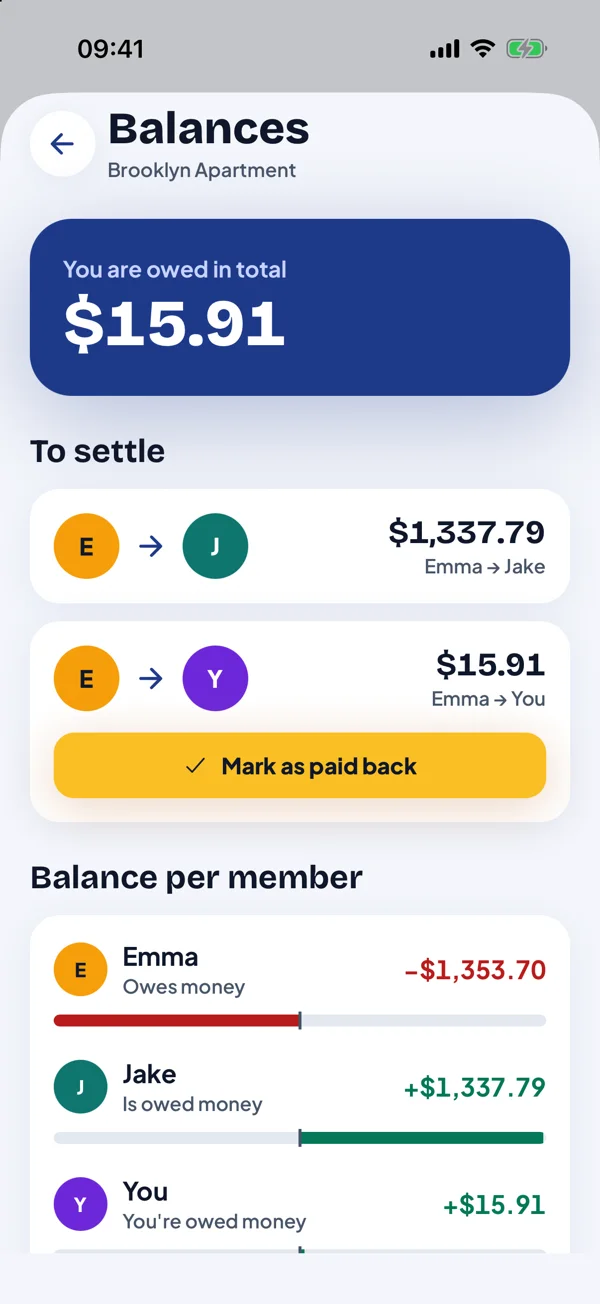
With SAVY, you create a household for the party and invite your friends with a link valid for 7 days. Each person adds what they paid and picks who takes part in each expense, for example only the drinkers for the champagne. SAVY works out who owes whom with a simplified list of repayments. The free plan includes unlimited expenses, equal splits, up to 4 members and 1 household of your own. For more than 4 people, SAVY Plus, one subscription for the whole household, adds unlimited members and uneven splits.
SAVY doesn't connect to your bank: expenses are entered manually and the app doesn't move money. Everyone pays back with their usual method. For a family celebration, see also our guide on splitting Christmas costs with family.
Frequently asked questions
How much should you charge per person for a New Year's Eve party?
There is no standard amount: it depends on the menu, the drinks and the venue. The simplest approach is to estimate the total for food, drinks and any rental, divide it by the number of guests, then add a small buffer for surprises. Put the amount in the invitation, and give back anything left over.
Should people who don't drink pay for the alcohol?
No, unless the group agrees otherwise. The fairest approach is to split alcohol only between those who drink, and food, soft drinks and decorations between everyone. Just record alcohol as a separate expense with its own participants.
Who pays when you celebrate New Year's Eve at someone's home?
Usually the host provides the place and guests chip in for food and drinks, or each bring something. The host doesn't have to pay for everyone's night. If the host fronts the groceries, guests pay them back equally.
How do you set up a shared pot for New Year's Eve?
Set an amount per person, ask everyone to pay it before the shopping, and pick one person to buy everything with it. Keep the receipts to show where the money went. At the end, give back what is left equally, or ask for a top-up if the budget ran over.